
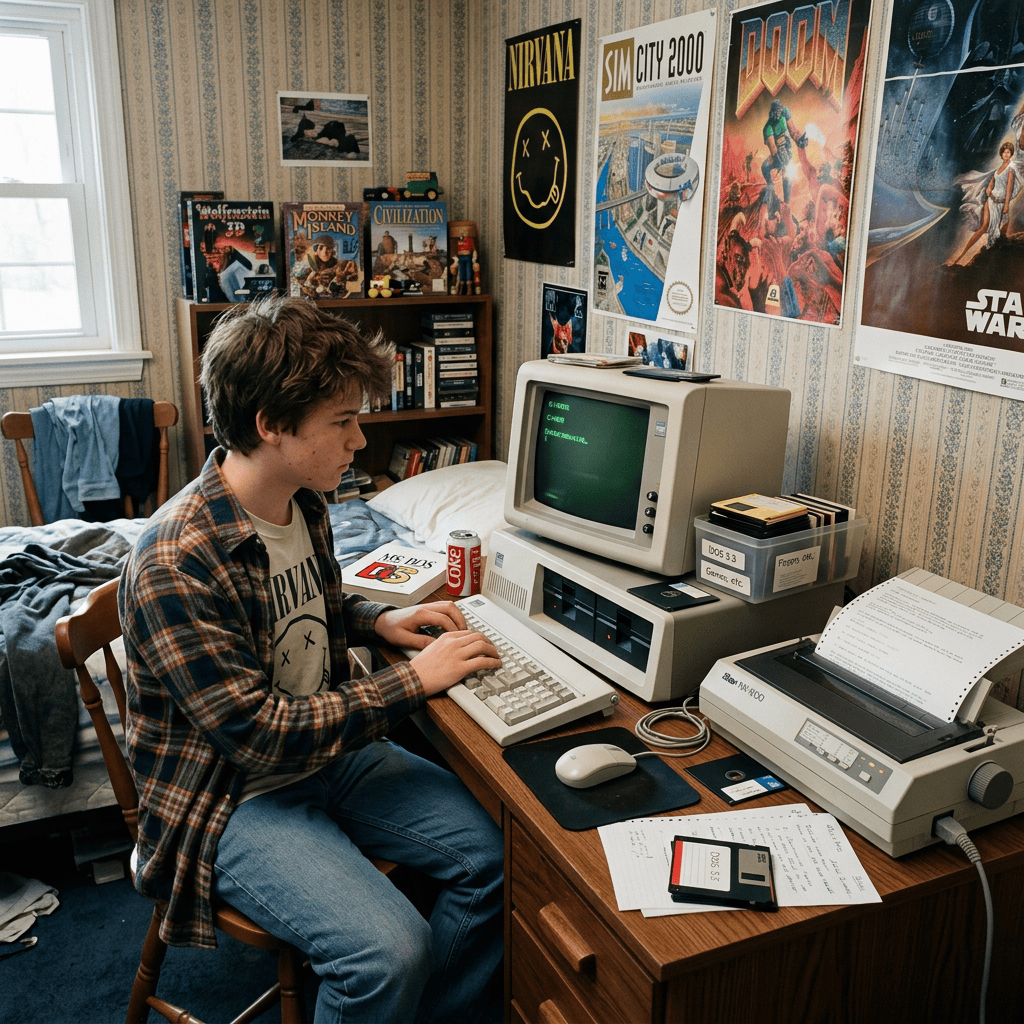
The Long Road From the Blinking Cursor
A Story of How We Learned to Talk to Machines — and How They Learned to Talk Back
Part I: The Blinking Cursor (1980s)
There was a sound that defined a generation, though you won’t find it in any history book.
Click. Whirrrrrr.
It was the sound of a floppy disk sliding into a drive — a 5.25-inch square of flexible plastic that held your entire world in 360 kilobytes. Less than a single photograph on today’s phone. But back then, it was everything.
The IBM PC XT sat on desks like a quiet, beige cathedral. It had a 10-megabyte hard drive — a marvel in its time — and a green phosphor screen that glowed in dark rooms like a lighthouse in a storm. When you turned it on, there was no music, no logo, no welcome animation. Just a black screen and a single line of white text:
C:\>
That blinking cursor was a doorway. But only if you knew the words.
You typed dir to see what was on your disk. You typed copy to duplicate a file. You typed edit to write a document, format to erase everything. The machine didn’t guess what you wanted. It didn’t suggest, autocomplete, or anticipate. It waited. And if you typed the wrong command, it responded with the cold honesty of a machine that didn’t care about your feelings:
Bad command or file name
Parents bought these machines and put them in their children’s bedrooms, not entirely sure why. “It’s for their education,” they said, as if the machine itself would teach. It didn’t. But it did something better. It taught you that if you wanted something from a machine, you had to learn its language. And its language was precise. Unforgiving. Beautiful.
A twelve-year-old sitting in a quiet room at midnight, typing mkdir to create a folder for the first time, felt something that no textbook could capture. It was the feeling of creation through command. You spoke, and the machine obeyed. You misspoke, and it ignored you. There was no middle ground.
The DOS prompt was not user-friendly. It was not warm. But it was honest — and that honesty created a generation of people who understood that computers were not magic. They were logic, made physical.
The XT had no internet. No email. No network at all, unless you were lucky enough to own a modem — a device you placed your telephone handset onto, literally, so that it could scream analog tones at another modem across a city, a country, a continent. 300 bits per second. A single character took longer to arrive than a heartbeat.
But it arrived. And that was enough to change everything.
Part II: The First Bridge (Early 1990s)
The Intel 8086 and its descendants were the engines, but they were engines without roads. The roads came later — built by people who believed that computers shouldn’t sit alone.
FTP — File Transfer Protocol — was one of the first roads. It was not the web. There were no pages, no links, no images. There were directories. You connected to a server at a university or a research lab, and you saw a list of files. You navigated with commands that felt like DOS: cd, ls, get. You downloaded a file and waited — sometimes hours — as bytes trickled through a phone line at 14.4 or 28.8 kilobits per second.
There was no browsing. There was no surfing. There was retrieving.
You had to know where you were going. There were no search engines. Someone would tell you — on a bulletin board, in a magazine, through a friend — “There’s a file at ftp://ftp.simtel.net/pub/msdos/ that does what you need.” And you would type that address like a key into a lock, and if the server was awake and your connection held, the door would open.
It felt like breaking into a library after hours. The lights were off. There was nobody at the desk. But the books were there, and you could take what you wanted, and nobody charged you anything.
The people who lived in this world were small in number but enormous in passion. They were students, engineers, hobbyists, and dreamers. They understood something that the rest of the world wouldn’t understand for another decade: that the value of a computer was not in what it computed, but in what it connected.
A modem connecting to an FTP server was the first whisper of a promise: you are not alone at that desk.
And then the whisper became a roar.
Part III: The World Wide Web (Mid-1990s to Early 2000s)
The Intel Pentium arrived like a muscle car in a village of bicycles.
It was fast. Dramatically fast. The original Pentium ran at 60 megahertz — five times faster than the 80486 it replaced. And with that speed came something that the 8086 could never have supported: graphics.
Not the wireframe graphics of engineering workstations or the blocky sprites of game consoles. Real, rendered, clickable, navigable graphics. Windows 95 gave the world the Start button. But more importantly, it gave the world a reason to go online that didn’t require typing commands.
And then came Netscape.
Netscape Navigator was not the first web browser. But it was the first one that mattered. When Marc Andreessen and his team built it, they didn’t just create a tool — they created a window. You launched Netscape, and a page loaded, and for the first time, the internet had design. There were headings and paragraphs. There were hyperlinks — blue, underlined text that you clicked, and suddenly you were somewhere else. It was the closest thing to teleportation that humanity had ever built.
The URL bar became a magic wand. Type http://www.yahoo.com and you were at a directory of the entire internet — because back then, the entire internet could fit in a directory. Type http://www.geocities.com and you were in a neighborhood of personal homepages, each one built by someone who had never built anything before, each one decorated with animated GIFs and MIDI music files and visitor counters that proudly displayed: You are visitor number 00042.
And then America Online — AOL — brought the internet to everyone.
AOL didn’t appeal to engineers. It appealed to families. You installed the software from a CD-ROM that arrived in your mailbox — uninvited, relentless, appearing like a quarterly subscription to the future. “You’ve got mail,” said the voice, and an entire generation felt their heart skip a beat. Email became personal. Email became emotional.
AOL Keywords turned the web into a scavenger hunt. “AOL Keyword: Disney” took you to Disney. “AOL Keyword: Nike” took you to Nike. It was a walled garden, yes — but it was a garden, and most people had never seen a garden before. Before AOL, the internet was a desert that required survival skills. After AOL, it was a place where your aunt could send you a forwarded joke and your grandmother could discover a recipe forum.
The Pentium powered this revolution. It decoded the images. It rendered the tables. It ran the early Java applets that made pages feel alive. And as the Pentium gave way to the Pentium II, the III, the IV — each one doubling, tripling, quadrupling in speed — the web grew from text to images to audio to animation to video.
By the early 2000s, the web was no longer a thing you visited. It was a place you lived. You had an email address. You had a screen name. You had a buddy list that showed you who was online, and when someone logged in, their name appeared with a sound, and you felt a small spark of connection that the DOS prompt generation could never have imagined.
The world had changed. But it was about to change again — because the web was about to escape the desk.
Part IV: The World in Your Pocket (Mid-2000s to 2010s)
The first time someone opened a web browser on a phone, it was a joke. The screen was the size of a postage stamp. The connection was slower than the old modem. Pages loaded in fragments — a headline here, half an image there, a layout that looked like a newspaper after an earthquake.
But then something shifted. Not in the technology — in the behavior.
YouTube launched in 2005, and it did something that no technology had ever done before: it made everyone a broadcaster. Before YouTube, if you wanted to share video, you needed a television station. After YouTube, you needed a camera and an opinion. A cat playing a keyboard could get more views than a cable news program. A teenager in a bedroom could reach more people than a newspaper with a century of history.
This was not a technological shift. It was a human shift. The internet had always been about retrieving information — you go to a site, you take what you need. YouTube made it about sharing. You create something, you upload it, and the world comes to you.
The iPhone arrived in 2007 and redefined what “going online” meant. You didn’t sit down. You didn’t boot up. You didn’t wait for a dial tone. You pulled a device from your pocket, tapped a glass surface, and you were there. The web was no longer a destination. It was a companion.
Mobile networks evolved — 3G, then 4G — and with each generation, the pipe widened. Video that once took minutes to buffer now played instantly. Apps replaced bookmarks. Push notifications replaced the “You’ve got mail” voice. Instead of one device connecting to the internet, every device connected.
Tablets. Smartwatches. Fitness trackers. Thermostats. Doorbells. Light bulbs.
Things that had never been computers were suddenly computers. And things that had never been connected were suddenly online.
This was the beginning of a new era — one that the engineers at FTP servers and Netscape developers had never imagined, but had quietly built the foundation for.
Part V: The Machine That Listens (Now)
We are here now. And “here” is strange.
The blinking cursor of the DOS prompt demanded that you learn its language. The AI that sits inside your phone, your laptop, your car, your home — it learns yours.
You don’t type commands. You speak. You don’t search keywords. You ask questions. You don’t navigate menus. You describe what you want, and the machine interprets, anticipates, and responds.
A farmer in Hokkaido checks soil moisture sensors connected to the internet — not through a dashboard of numbers, but through a conversation with an AI that says, “The north field needs water. I’ve scheduled irrigation for 5 AM.” An elderly woman in Tokyo talks to a device on her table and it reminds her to take medication, calls her daughter if she doesn’t, and orders groceries when her fridge reports that the milk is low.
This is IoT — the Internet of Things — and it is the final erasure of the line between digital and physical. The FTP servers of the 1990s connected computers to computers. The web of the 2000s connected people to information. The mobile era connected people to people. The IoT era connects things to things — and AI sits in the middle, translating.
A vending machine in Jakarta reports its own inventory to a server in Japan, which predicts when it will run out of stock, which automatically places an order with a distributor, which triggers a delivery route optimized by an algorithm that learned the city’s traffic patterns. No human touched that process. But a human built every piece of it — each one standing on the shoulders of the last.
The Intel 8086 could execute 0.33 million instructions per second. The chip inside a modern smartphone can execute trillions. But the distance between those numbers is not the real story. The real story is what happened to the interface — the space between human and machine.
In the DOS era, that space was vast. You had to cross it. You had to learn, study, memorize, practice. The machine would not meet you halfway.
In the web era, that space narrowed. You clicked, you scrolled, you navigated. The machine tried to help — with menus and buttons and bookmarks — but it still required you to understand its structure.
In the mobile era, that space became intimate. The device was always with you. It knew your location, your contacts, your habits. It began to anticipate.
In the AI era, that space has nearly disappeared. You speak naturally, and the machine understands. You gesture, and it responds. You exist, and the sensors around you quietly adjust the world to your presence.
Epilogue: The Road Behind, The Road Ahead
If you had told the twelve-year-old sitting at a DOS prompt in 1985 that one day, a device smaller than a paperback book would hold more information than every library on Earth, respond to spoken questions in any language, and connect to a global network of billions of devices — that child would have stared at you with the green glow of a phosphor screen reflecting in their eyes, and they would have said: “Prove it.”
They wouldn’t have believed you. Not because they lacked imagination, but because the distance was too great. Between C:\> and a conversation with an AI, there is a chasm so wide that an entire generation of engineers, designers, dreamers, and ordinary people had to build the bridge — one protocol, one browser, one app, one device at a time.
The bridge is not finished. It will never be finished.
But here is the thing worth remembering — the thing that makes this story emotional and not just educational:
Every step of this journey was built by people who were afraid. Afraid they didn’t understand the technology. Afraid they were too late, too old, too unprepared. The people who built Netscape were barely out of college. The people who built YouTube were nobody’s idea of media executives. The people who are building AI today are not certain they are building it right.
They built anyway.
That’s the lesson that travels from the XT to the AI — from the cursor to the conversation. The technology changes. The fear doesn’t. But neither does the solution: you build anyway. You learn the commands, even when they’re unfamiliar. You connect, even when the connection is slow. You create, even when you’re not sure anyone is watching.
Because someone is always watching. Someone is always about to build the next thing on top of what you built.
And the road that started with a blinking cursor on a green screen is still being paved — now by machines that learn, by sensors that feel, and by people who refuse to let the future arrive without them in it.
From C:\> to conversation. From 360 kilobytes to the cloud. From one computer, alone, to everything, connected.
The road was long. The road goes on.

