
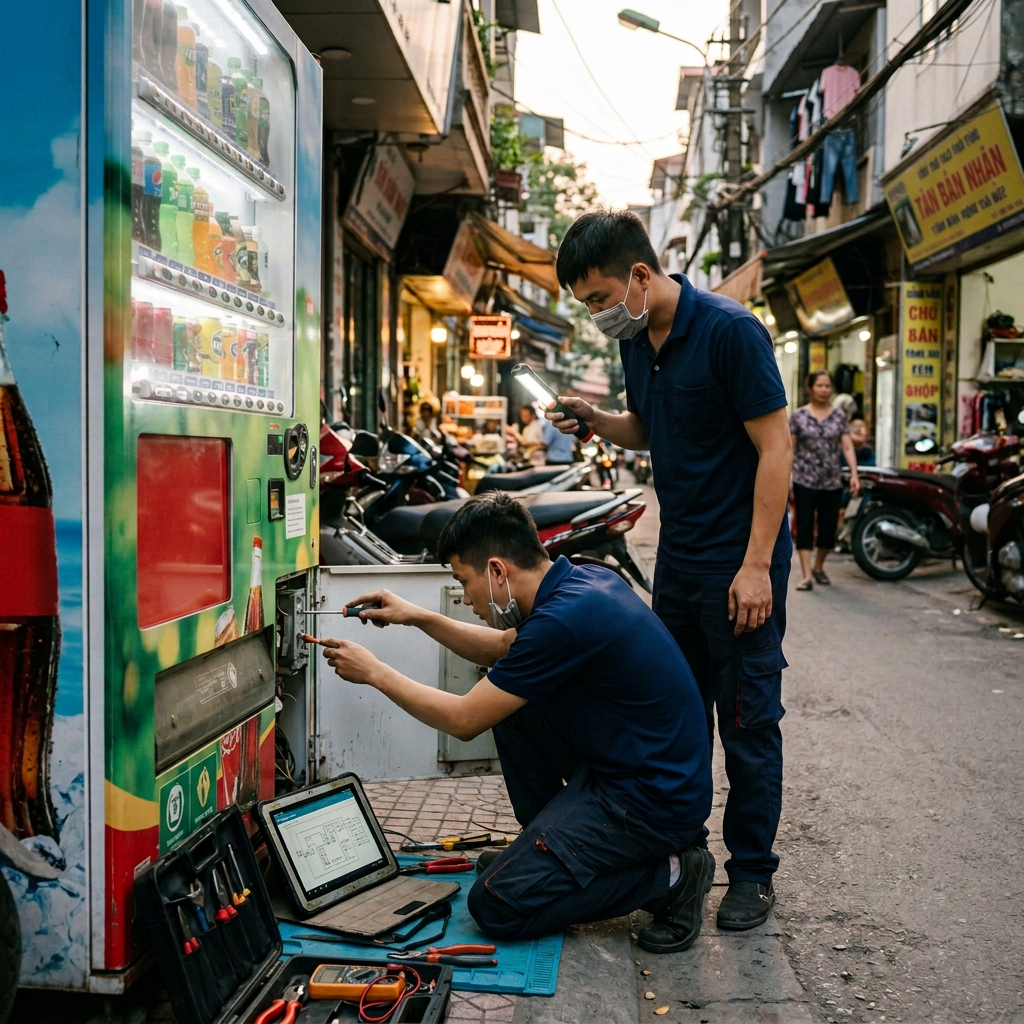
JAGO AI: The Ishikawa Startup Teaching Japanese Vending Machines to Speak 12 Languages
JAPANTOGO LLC’s offline-capable diagnostic chatbot is cutting vending machine service calls by 30% across six countries — and it’s built on a surprisingly simple premise.
By Talus | August 2, 2026
HAKUSAN, ISHIKAWA — Japan maintains over 5 million vending machines nationwide — the highest density of any country on Earth. Fuji Electric, one of the dominant manufacturers, exports these machines to markets stretching from Southeast Asia to Europe and North America. But every exported unit carries a persistent problem: when something fails, the machine displays a cryptic two-digit error code in a service menu that’s only documented in Japanese.
For technicians in Kuala lumpur, Berlin, or Los Angeles, that code is meaningless without access to the original manufacturer manual — which, in most cases, never left the factory.
A small export company in Ishikawa Prefecture has built a solution that’s quietly changing how vending machine maintenance works globally. It’s called JAGO AI, and it’s a mobile-first diagnostic chatbot that decodes Japanese vending machine error codes in real time, in 12 languages, with offline capability.
The Problem: World-Class Hardware, Zero Service Documentation
JAPANTOGO LLC, an export import company based in Hakusan, has been exporting Fuji Electric vending machines for years. Their machines operate in Indonesia, the USA, Malaysia, Germany, Singapore, and Thailand.
The hardware is robust. Fuji Electric’s FGS260W glass-front model — one of the most widely deployed units in Japan — uses configurable rack systems (single spiral, double spiral, conveyor belt) and is designed for decades of continuous operation. The FAE36M6RF807 PET/CAN model features a 6-layer serpentine dispensing mechanism with hot-and-cold capability and a touchscreen interface.
But when a compressor overloads, a coin mechanism fails, or a delivery motor jams, the machine responds with a numeric code — E-90, H-10, P-37 — and nothing else. No localized error description. No troubleshooting flowchart. No multilingual support line.
“The machines are excellent. The support infrastructure for exported units is essentially nonexistent,” according to field reports from technicians using JAGO.
How JAGO AI Works
JAGO AI operates as a conversational interface — accessible via mobile app or web browser — that accepts three inputs: error code, machine model, and symptom description. It then cross-references these against a proprietary database of Fuji Electric technical manuals, historical repair logs, and model-specific failure patterns.
The system performs symptom-based analysis: rather than simply translating an error code, it correlates the reported symptoms (e.g., “not cooling,” “products not dispensing,” “payment system unresponsive”) against known failure modes for the specific model and environment. The output is a prioritized repair procedure with safety warnings, component diagrams, and target measurement ranges.
Architecture Overview
| Layer | Function |
|---|---|
| Input | Error code + model number + symptom description (text or voice) |
| NLP Engine | Multilingual parsing — 12 languages including Japanese, English, Thai, Indonesian, German, Mandarin |
| Diagnostic Database | Fuji Electric manufacturer manuals, component specs, historical repair logs |
| Pattern Matching | ML-based cross-referencing of symptoms against failure mode patterns |
| Output | Step-by-step repair instructions with diagrams, safety warnings, and measurement guides |
Case Study: Bangkok Field Test
In a documented field incident in Bangkok, a Fuji Electric vending machine displayed Error E-90 (Refrigeration Compressor Overload) at a high-traffic retail location. The local technician had no manufacturer manual, no access to Japanese-language support, and the nearest authorized service center was approximately 400 km away.
JAGO AI, running on the technician’s smartphone, auto-detected Thai as the interface language based on device locale settings. The technician entered the error code and symptom (“not cooling”). JAGO returned a diagnosis in four seconds:
- Root cause candidates: Dirty condenser coils, low refrigerant, or failing fan motor
- Prioritized repair procedure: 6-step guide with safety warnings, component photos, and measurement parameters
- Estimated time: 15–20 minutes for standard coil cleaning
The technician identified severely soiled condenser coils — accumulated dust and grease from extended operation in a high-humidity urban environment — as the root cause. After cleaning and fan inspection, the unit resumed normal operation. Total downtime: 22 minutes. No service dispatch required.
Measured Impact
Preliminary data from vending machine operators using JAGO AI shows significant operational improvements:
| Metric | Improvement |
|---|---|
| Average resolution time | 50% faster vs. manual diagnosis + phone support |
| Service call frequency | 30% reduction — technicians self-resolve without dispatching engineers |
| Language coverage | 12 languages — Japanese, English, Thai, Indonesian, German, Mandarin, Malay, Korean, Vietnamese, Spanish, Portuguese, French |
| Connectivity requirement | Offline-capable — core diagnostics cached locally |
| Supported models | Fuji Electric FGS260W, FAE36M6RF807, Frozen Station II, FLS140WRXL4-A, and legacy models |
Predictive Maintenance: Beyond Reactive Diagnostics
JAGO’s more advanced capability moves from reactive to predictive maintenance. By monitoring sensor data over time — compressor efficiency, temperature variance, cooling cycle frequency — the system identifies gradual degradation before it triggers a hard error.
Example: if compressor efficiency drops 8% over a 30-day window, JAGO generates a preventive maintenance alert: “Compressor efficiency has declined. Schedule condenser maintenance within 2 weeks to prevent Error E-90.”
This shifts the maintenance model from break-fix to predict-and-prevent — the same approach used in industrial IoT deployments by companies like Siemens and GE, but applied to vending machine infrastructure at a fraction of the cost and complexity.
The Competitive Landscape
Major Japanese vending machine manufacturers — have historically maintained closed support ecosystems. Error code documentation is proprietary, service manuals are distributed only to authorized technicians, and the support infrastructure is Japan-centric.
JAGO AI represents a third-party approach: an independent diagnostic layer that sits on top of exported hardware and makes manufacturer-specific knowledge accessible to anyone, in any language. It’s an open solution to a closed-system problem.
This positions JAPANTOGO not just as an exporter, but as a service platform — a company whose value extends beyond the hardware sale into the operational lifecycle of the machine. For operators, that means lower maintenance costs and higher uptime. For JAPANTOGO, it means a recurring relationship with every machine they export.
Statement from JAPANTOGO LLC
“We don’t build AI to replace people. We build it to give Japan new advantages — more time for family, stronger communities, and a brighter future for our children.” — Founder, JAPANTOGO LLC
The Bigger Picture
Japan’s vending machine industry generates over ¥6 trillion annually in domestic sales. The export market — while smaller — is growing, driven by demand in Southeast Asia for Japanese-quality automated retail infrastructure. But hardware exports without support infrastructure create friction: machines break, nobody can fix them, and the next order doesn’t come.
JAGO AI solves the support gap. It’s not a general-purpose AI — it’s a domain-specific diagnostic tool built on deep knowledge of a single product category. That narrow focus is its strength. While large tech companies chase broad AI platforms, JAPANTOGO has built something that does one thing exceptionally well: keep Japanese vending machines running, anywhere on the planet, in whatever language the technician speaks.
In a market where uptime is revenue, that’s not a novelty. It’s infrastructure.
JAPANTOGO LLC is a registered company based in Hakusan, Ishikawa, Japan. Contact: togojapan@japanasiatrade.com | +81-50-5470-4831 | japanasiatrade.com

