
The Machine That Speaks 12 Languages
How a small company in Ishikawa taught AI to save Japanese vending machines — one error code at a time
It was 2 AM in Hakusan, and the office lights were still on.
Not because anyone had ordered overtime. Not because a deadline was breathing down anyone’s neck. The lights were on because the team at JAPANTOGO LLC had stumbled onto a question they couldn’t put down:
What if the machines could tell us what’s wrong with them — in any language, anywhere in the world?
It sounds simple now. But at the time, it wasn’t. Japanese vending machines are extraordinary pieces of engineering — rugged, precise, built to run for decades. But when they break, they break quietly. A two-digit code flashes on a screen. No explanation. No context. Just a number, glowing in the dark, meaningless to anyone who doesn’t have the right manual — and the right manual is almost always in Japanese.
JAPANTOGO knew this better than anyone. They had been exporting Fuji Electric machines to Indonesia, the USA, Malaysia, Germany, Singapore, and Thailand. Every export came with the same problem: a brilliant machine, stranded in a country where nobody could read its error codes.
So they built JAGO.
Bangkok. 1:47 PM. 41°C.
Rafael was sweating. Not from the heat — from the pressure.
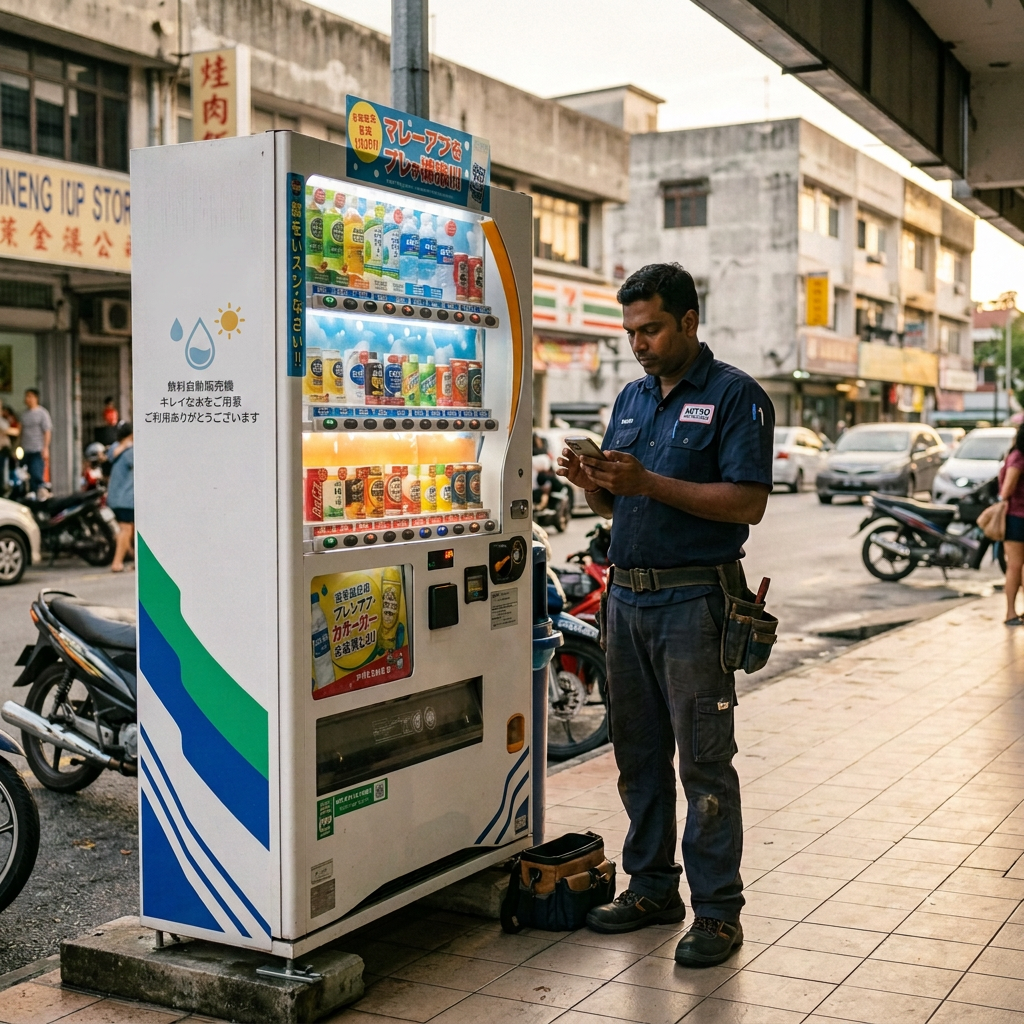
The vending machine outside the convenience store had been down for three hours. The screen flashed “E-90” in red, blinking like a heartbeat that was about to stop. The store owner was losing money with every passing minute. Customers walked up, saw the dark screen, and walked away.
Rafael was a good technician. He could fix motors, replace belts, calibrate sensors. But E-90 meant nothing to him. He had no manual. The manufacturer’s support line was in Japanese. The nearest authorized repair center was 400 kilometers away.
He pulled out his phone. Not to call someone — to talk to something.
He opened JAGO AI.
“Hello. I’m JAGO AI. What seems to be the problem?”
The greeting came in clear, calm Thai. Rafael hadn’t even selected a language — JAGO had detected it from his phone’s settings.
He typed: “Error E-90. Fuji Electric vending machine. Not cooling.”
JAGO responded in four seconds.
“Error E-90 indicates: Refrigeration Compressor Overload. Common causes: dirty condenser coils, low refrigerant, or failing fan motor. Would you like step-by-step repair instructions?”
Rafael typed: “Yes.”*
And JAGO didn’t just give him text. It gave him a plan.
Step 1: Turn off power and unplug the machine. ⚠️ Do not skip this step — electrical hazard present.
Step 2: Remove the rear panel using a Phillips-head screwdriver. (Photo attached showing screw locations.)
Step 3: Locate the condenser coils at the bottom rear. Clean with a soft brush and vacuum. Tip: If coils are heavily soiled, use coil cleaner spray — available at most hardware stores.
Step 4: Check the cooling fan for dust buildup or physical damage. Spin it manually — it should rotate freely with no grinding noise.
Step 5: If the fan is functional and coils are clean, measure refrigerant pressure using a manifold gauge. (Guide attached with target pressure ranges for your model.)
Step 6: Restart the machine and monitor for 15 minutes. If E-90 reappears, the compressor relay may need replacement — JAGO can guide you through that process as well.
Rafael followed each step. At Step 3, he found the condenser coils caked with dust and grease — months of Bangkok humidity and street pollution had turned them into a blanket. He cleaned them. He checked the fan. It spun clean.
He plugged the machine back in.
The compressor coughed. Paused. Then hummed to life — that deep, steady, reassuring sound that every vending machine technician knows by heart. Cold air began flowing through the vents. The temperature display started dropping.
Total downtime: 22 minutes.
The store owner came out, saw the machine running, and put his hand on Rafael’s shoulder. He didn’t say anything. He didn’t need to.
Rafael looked at his phone. JAGO was still on screen, displaying: “Repair complete. I’ve logged this incident for future reference. If this error recurs within 30 days, I recommend scheduling a preventive maintenance check. Is there anything else I can help with?”
He closed the app. He didn’t answer. But he smiled.
From Bangkok to Berlin to KUALA LUMPUR to Rural Japan
Rafael’s story is not unique. It happens every day.
In KUALA LUMPUR, a technician encounters Error H-10 — a payment system fault. JAGO identifies it as a coin mechanism connector issue, walks him through reconnection, and saves a four-hour service call.
In Bremen, Germany, a vending operator sees Error P-37 — a product delivery jam. JAGO explains it’s a spiral motor misalignment, sends a diagram, and the operator fixes it himself. In German.
In rural Japan, an elderly shopkeeper who has operated the same vending machine for 15 years watches it display Error 10. She doesn’t call a technician. She asks JAGO — in Japanese, speaking aloud to her phone because her hands are stiff from decades of work. JAGO listens, explains that Error 10 means a coin mechanism fault, and tells her exactly which cable to check. She fixes it in ten minutes.
In New York, a Cat Cafe manager troubleshoots a PET bottle machine with JAGO in English. In Singapore, a technician diagnoses a hot-and-cold cup machine with JAGO in Mandarin.
Twelve languages. One AI. Built in Ishikawa, Japan — a prefecture better known for gold leaf and traditional crafts than for cutting-edge software.
The Numbers Behind the Story
This isn’t just storytelling. The impact is real:
- 50% faster resolution times for vending machine operators using AI-assisted diagnostics
- 30% reduction in service calls — because technicians fix problems themselves instead of waiting for engineers
- 12 languages supported — making Japanese engineering accessible worldwide
- Offline capability — because the machines that need fixing most are often in the places with the worst internet
JAGO works because it combines something that doesn’t usually go together: deep technical knowledge of Japanese vending machine engineering and real-world repair experience from technicians across six continents. It doesn’t just translate error codes. It understands them — cross-referencing symptoms against historical patterns, suggesting fixes tailored to the specific model, environment, and failure mode.
In advanced cases, JAGO doesn’t wait for the error. It predicts it. A sensor reading slightly outside normal range triggers a quiet warning: “Your compressor efficiency has dropped 8% this month. Consider preventive maintenance within 2 weeks to avoid Error E-90.”
The machine hasn’t broken yet. But JAGO already knows it will — and it’s already telling someone how to stop it.
Why It Matters
Japan has more vending machines per capita than any country on Earth — over 5 million. They are on every street corner, in every train station, outside every rural temple. They sell hot coffee in winter and cold corn soup in summer. They are part of the rhythm of Japanese life — so reliable that most people never think about them, the way you never think about your heartbeat.
But machines age. Parts wear. Compressors fail. And when they do, the convenience that defines modern Japan stutters — not just in Japan, but everywhere that Japanese machines have traveled.
JAPANTOGO built JAGO because they understood something that bigger companies often miss: technology doesn’t serve society by being impressive. It serves society by being useful — quietly, reliably, and in the moments when nobody is watching.
“We don’t build AI to replace people,” said the founder of JAPANTOGO LLC. “We build it to give Japan new advantages — more time for family, stronger communities, and a brighter future for our children.”
That’s the real story. Not the AI. Not the error codes. Not the twelve languages.
The real story is a team in Ishikawa, working late, asking a simple question — and refusing to stop until the answer was good enough to help a sweating technician in Bangkok fix a machine in twenty-two minutes, half a world away.
That’s what Japanese engineering has always been about. JAGO is just the latest way of telling that story.
 JAGO ARTIFICIAL INTELLIGENCE
Leave a comment